The Story of Paolo and Francesca
The Story of Paolo and Francesca is the most famous and emotionally devastating episode in Dante Alighieri's Inferno, occurring in Canto V of the Second Circle, where the lustful are punished by an infernal hurricane. Francesca da Rimini narrates how she and her brother-in-law Paolo Malatesta fell into adultery while reading the story of Lancelot and Guinevere, a sin for which they were murdered by her husband, Paolo's brother. Their tale crystallizes the poem's central tension between human love and divine justice, and its telling causes Dante to swoon with pity, marking the first profound crisis of compassion in his journey through Hell.
The Setting and the Sinners
The Second Circle of Hell is a place "mute of all light," which "bellows as the sea does in a tempest, if by opposing winds 'tis combated." An infernal hurricane that never rests hurtles the spirits onward in its rapine, whirling them round and smiting them. When they arrive before the precipice, there are shrieks, plaints, and laments, and they blaspheme the puissance divine. Dante understands that unto such a torment the carnal malefactors are condemned, "who reason subjugate to appetite." As the wings of starlings bear them on in the cold season, so does that blast drive the spirits maledict, driving them hither, thither, downward, upward, with no hope of repose, not even of lesser pain. As the cranes go chanting forth their lays, making in air a long line of themselves, so Dante sees shadows borne onward by the aforesaid stress, uttering lamentations. Among these, Virgil names Semiramis, Dido, Cleopatra, Helen, Achilles, Paris, and Tristan, before Dante's attention fixes on two souls who go together and seem upon the wind to be so light.
Francesca's Narrative
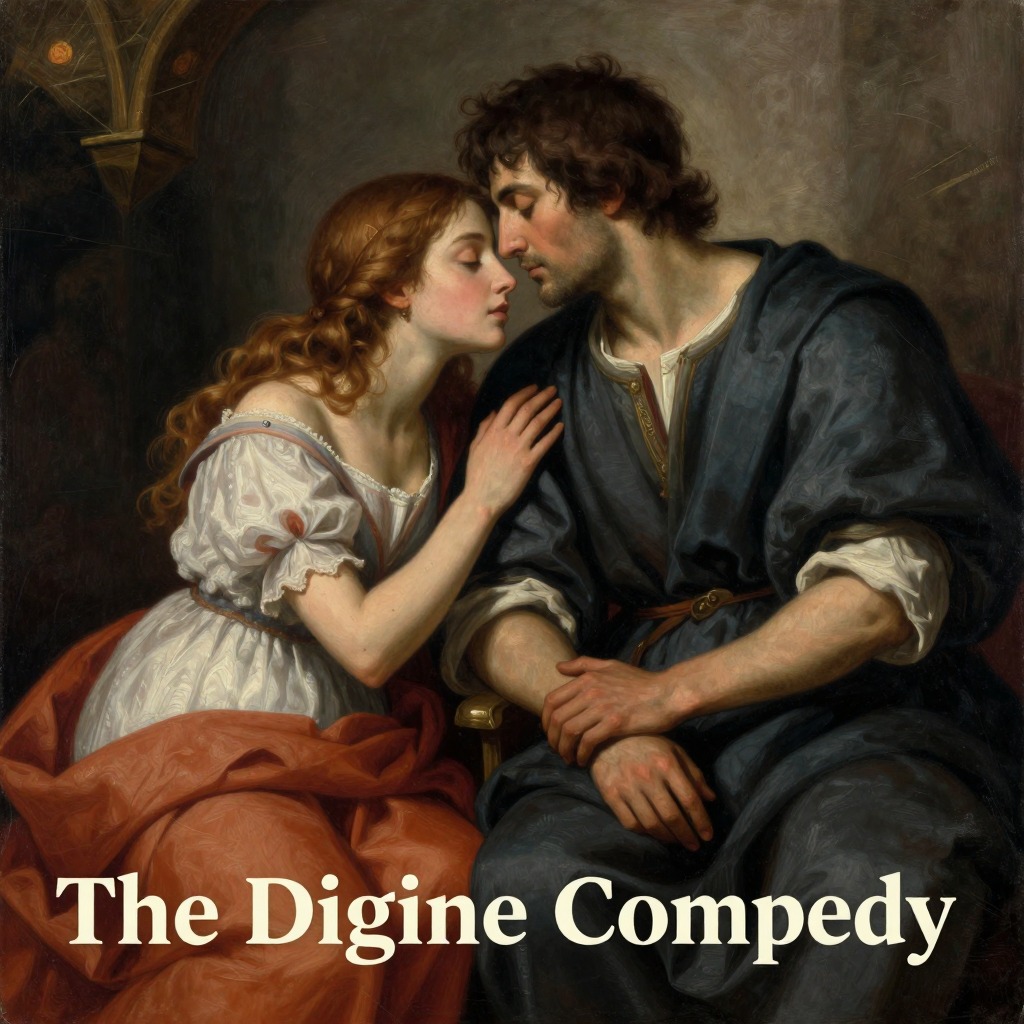
Dante calls to the two weary souls, and they approach "as turtle-doves, called onward by desire, with open and steady wings to the sweet nest." Francesca speaks first, identifying herself and her companion. She was born in Ravenna, on the sea-shore where the Po descends to rest in peace with all his retinue. Love, she explains, "that on gentle heart doth swiftly seize, seized this man for the person beautiful that was ta'en from me, and still the mode offends me." Love, "that exempts no one beloved from loving, seized me with pleasure of this man so strongly, that, as thou seest, it doth not yet desert me." Love has conducted them unto one death, and "Caina waiteth him who quenched our life!" — a reference to the murderer, her husband Gianciotto Malatesta, who will be punished in the lowest circle of Hell among traitors to kindred. When Dante asks how love conceded that they should know their dubious desires, Francesca replies with the famous line: "There is no greater sorrow than to be mindful of the happy time in misery." She then recounts the fatal moment: "One day we reading were for our delight of Launcelot, how Love did him enthral. Alone we were and without any fear. Full many a time our eyes together drew that reading, and drove the colour from our faces; but one point only was it that o'ercame us. When as we read of the much-longed-for smile being by such a noble lover kissed, this one, who ne'er from me shall be divided, kissed me upon the mouth all palpitating. Galeotto was the book and he who wrote it. That day no farther did we read therein."
Dante's Response and the Swoon
As Francesca speaks, Paolo weeps. Dante, overwhelmed by pity, bows his face and holds it down until Virgil asks him what he thinks. He answers: "Alas! how many pleasant thoughts, how much desire, conducted these unto the dolorous pass!" Turning to the souls, he addresses Francesca directly, saying her agonies make him sad and compassionate to weeping. After hearing her full account, and while the one spirit utters this, the other weeps so that, for pity, Dante swoons away as if he had been dying, and falls "even as a dead body falls." This is the first time in the poem that the protagonist physically collapses from emotional shock, and it establishes a pattern of compassionate response that Virgil will later need to correct.
Thematic Significance
The episode functions as a profound meditation on the nature of love, reading, and moral responsibility. Francesca's language echoes the courtly love tradition, but Dante the poet places it within a framework of divine justice that condemns the very passion it celebrates. The book itself becomes a "Galeotto" — a pander — implicating literature in the moral fall of its readers. The episode also introduces the principle of contrapasso: the lustful, who in life allowed themselves to be swept away by passion, are now eternally swept by the winds of the hurricane, never to rest. Dante's swoon represents the crisis of a pilgrim who must learn to reconcile human sympathy with the stern judgments of God, a lesson that will be tested repeatedly throughout his journey.
Narrative Role in the Poem
As the first extended encounter with a named sinner in Hell, the story of Paolo and Francesca establishes the emotional and ethical stakes of Dante's journey. It is the moment when the reader, like the pilgrim, is forced to confront the human reality behind the abstract categories of sin. The episode also introduces the technique of having the damned narrate their own stories, a device that gives the Inferno much of its dramatic power. Francesca's voice — eloquent, self-aware, and unrepentant — makes her one of the most memorable characters in all of literature, and her story has inspired countless works of art, music, and literature in the centuries since the Comedy was written.